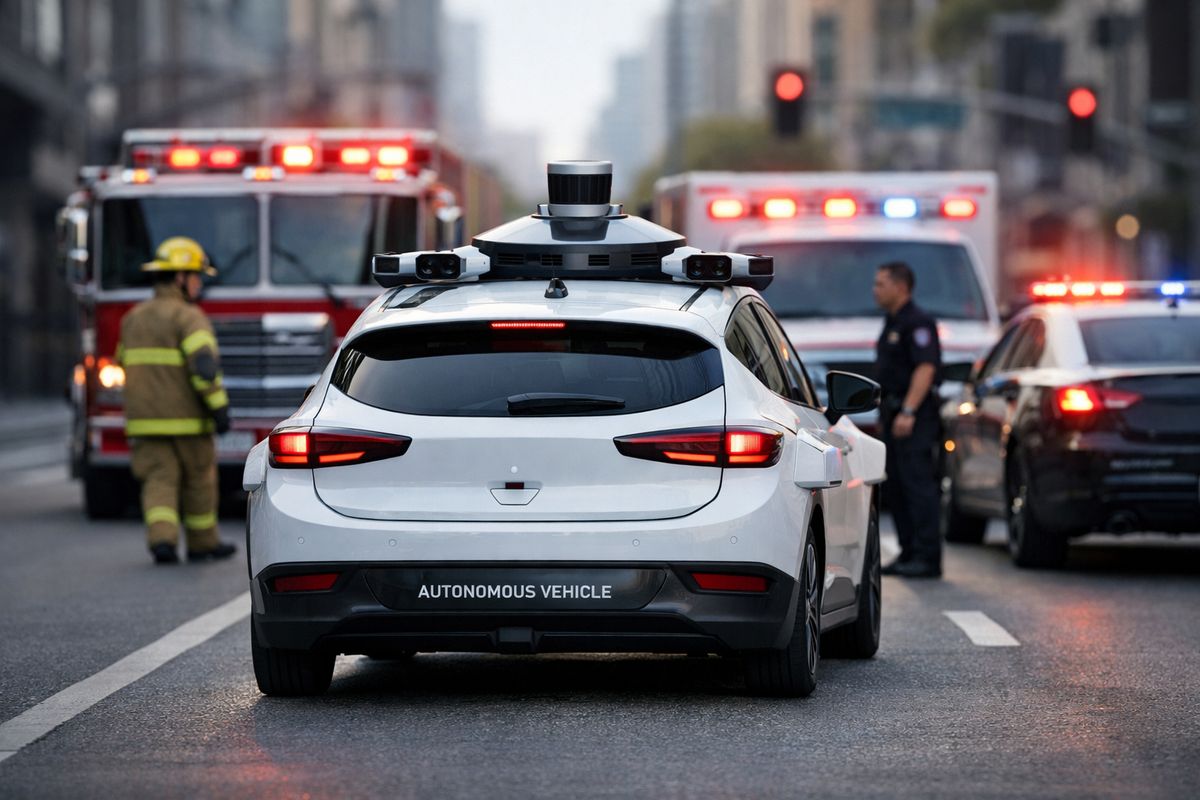
As autonomous mobility moves from pilot programs to real operations, one issue is becoming non-negotiable: vehicles must not obstruct first responders. For business leaders in the Barcelona area working on smart mobility, AI-enabled services, fleet operations, or urban transport technology, this is not only a safety matter. It is an operational governance issue that affects compliance, incident response, contracting, and public trust.
Fines for blocking emergency services are only the visible part of the risk. The larger business question is whether operators, platform owners, and service partners have the controls needed to prevent avoidable incidents and respond correctly when systems fail in the real world.
Why this matters beyond the fine
A blocked ambulance route or delayed fire response creates immediate exposure. The consequences can include regulatory scrutiny, service suspension, contractual disputes, insurance complications, and reputational damage. For operators of robotaxis and other AI-enabled mobility services, the issue quickly moves from technical performance to management accountability.
Decision-makers should treat this as a board-level operational risk. If a vehicle cannot reliably detect, interpret, and yield to emergency conditions, the operating model is incomplete. This applies whether the service is fully autonomous, remotely supervised, or supported by human intervention teams.
What regulators and city stakeholders will expect
Authorities and public stakeholders typically care less about how advanced the technology sounds and more about whether the service behaves predictably under pressure. That means emergency access must be designed into the operating model, not handled as an afterthought in product testing.
In practical terms, operators should expect scrutiny in four areas: incident prevention, escalation speed, auditability, and accountability. Can the system detect emergency vehicles and restricted zones? Can it hand over to a remote operator fast enough? Is every decision traceable? Is there a named owner for operational response?
Where robotaxi operators are often unprepared
Many mobility businesses focus heavily on vehicle capability but underinvest in operational controls. The gaps often appear in edge cases, especially when public infrastructure, emergency services, and software decisioning intersect.
Common weak points include unclear stop-and-yield logic, poor mapping of emergency access areas, inconsistent remote intervention procedures, fragmented ownership between engineering and operations, and weak communication protocols for incidents. A technically strong system can still fail operationally if responsibilities are unclear or response thresholds are too slow.
For companies in the Barcelona area exploring smart mobility deployments, this is particularly relevant as urban environments demand coordination between technology, service operations, and public-space constraints. The business challenge is not only to launch the service, but to make it governable under real operating conditions.
The operating model that reduces exposure
Leaders should approach this as a cross-functional design problem. Product, legal, operations, safety, procurement, and public affairs all need a shared framework. The right question is not whether the vehicle can drive autonomously most of the time. The right question is whether the organization can prevent, manage, document, and learn from exceptions.
A robust model usually includes clear emergency interaction rules, defined service boundaries, remote override procedures, incident command roles, event logging standards, and escalation paths linked to response time expectations. It also requires regular review of route logic, geofencing assumptions, and field procedures.
In many cases, this work sits within broader process optimization efforts, because the problem is not only algorithmic. It is procedural, operational, and managerial.
What business leaders should do next
Start with a readiness review. Map the full incident lifecycle from vehicle detection to human escalation, responder access, reporting, and post-incident review. Identify where decisions are automated, where humans intervene, and where responsibility changes hands.
Then test the model against realistic scenarios. What happens if a vehicle stops in a narrow access point? What happens if connectivity drops during a remote intervention? What happens if emergency instructions conflict with route logic? If your teams cannot answer these questions clearly, the risk is already operational.
Next, assign executive ownership. Compliance around emergency access cannot sit only with engineering. A senior operational owner should be accountable for controls, drills, evidence, and corrective actions.
How to prepare before regulators force the issue
The strongest operators do not wait for a penalty or a public incident to redesign their controls. They build compliance readiness early, using practical governance mechanisms: documented protocols, exception handling, simulation reviews, field escalation drills, vendor obligations, and measurable response standards.
For founders, CIOs, and operational managers, the lesson is straightforward. If autonomous or AI-enabled mobility services interact with public roads, emergency access is a business-critical process. Companies that treat it as such will be in a better position to scale, defend their operating model, and maintain stakeholder confidence.